Commercial truck sales, parts and service specialists

Freightliner / Class 8 / Battery-Electric Day Cab

eCascadia

Electric power. Real freight. A new working day.

Check availability
Vehicle class
Class 8
Power source
Battery electric
Day cab
116-inch BBC
Usable battery capacity
291 or 438 kWh; by configuration

Model overview

Electric power. Real freight. A new working day.

The Freightliner eCascadia brings battery-electric propulsion to a familiar Cascadia-based platform. Integrated Detroit ePowertrain, a quieter driver environment and connected fleet technology support short-haul and regional assignments where the truck, route and charging plan work together. This Class 8 tractor uses a 116-inch BBC day cab and offers three published drive-and-battery configurations.

At Francis Canada Truck Centre in Ottawa, we start with the freight you move and the working day the truck needs to complete. Compare the configurations below, then discuss the Canadian-market vehicle, charging and support arrangements for your operation. Published range and combination-weight figures need to be assessed against the actual route, load and conditions.

Sales resources

Build the right eCascadia

Discuss specifications, body applications, availability, and ordering with our commercial truck team.

Published vehicle combinations

Three configurations. One complete route to plan.

Typical range is based on target applications with diminishing loads and regenerative braking. It is not a guaranteed distance at maximum combination weight or in every season. Kilometres are approximate conversions of Freightliner’s mile figures.

GCW means the loaded tractor and trailer together, not cargo payload. Review the actual combination, axle loading and Canadian operating requirements. Power figures are alternative ratings, not continuous-versus-peak pairs.

4×2

Single drive: standard range

  • Usable battery: 291 kWh
  • Typical range: 155 miles / approximately 249 km
  • Maximum published GCW: 65,000 lb
  • Power options: 320 or 395 HP

A starting point for a defined assignment with a charging window that fits the route.

4×2

Single drive: long range

  • Usable battery: 438 kWh
  • Typical range: 230 miles / approximately 370 km
  • Maximum published GCW: 65,000 lb
  • Power options: 320 or 395 HP

Evaluate the additional usable energy alongside battery weight, the load and available charging time.

6×4

Tandem drive

  • Usable battery: 438 kWh
  • Typical range: 220 miles / approximately 354 km
  • Maximum published GCW: 82,000 lb
  • Power options: 425 or 470 HP

The higher published combination weight belongs to this drive configuration; confirm the completed tractor-trailer requirements.

Short-haul & regional applications

Find the assignment with a repeatable rhythm.

Begin with work you know well: leave the depot, move the freight and return with a plan for the next departure. A representative route reveals more than average daily distance alone.

Regional distribution

Map the loaded departure, sequence of customers and return journey. A route that gets lighter through the day differs from a heavily loaded terminal run. Include the required reserve and the trip back to the charger when assessing the assignment.

Warehouse shuttles

Known facilities and repeated trips make loading, travel, unloading and charging windows easier to describe. Identify which site supplies charging and when the truck can connect. A consistent route still needs dependable time before its next departure.

Intermodal & drayage

Include terminal queues, container weight, chassis requirements and possible extra movements. Assess the complete trip between the terminal, customer and charging location so dispatch has a plan for normal variation as well as the shortest movement.

Dedicated delivery

Review trailer exchanges, departure times and how often the route changes. For refrigerated freight, assess the trailer’s refrigeration power separately: an electric tractor does not determine how other equipment is powered or the emissions of the complete combination.

Detroit ePowertrain

Electric by design, from the batteries to the axle.

Detroit ePowertrain integrates batteries, eAxles and electronic controls with the vehicle’s safety systems and connectivity. Each eAxle brings electric motors, transmission components and power electronics into a compact drive unit.

The result is responsive acceleration and smooth power delivery within a complete electric architecture. Describe loaded starts, grades and trailer positioning when choosing the drive configuration; the appropriate rating needs to work with the route and the energy available for the shift.

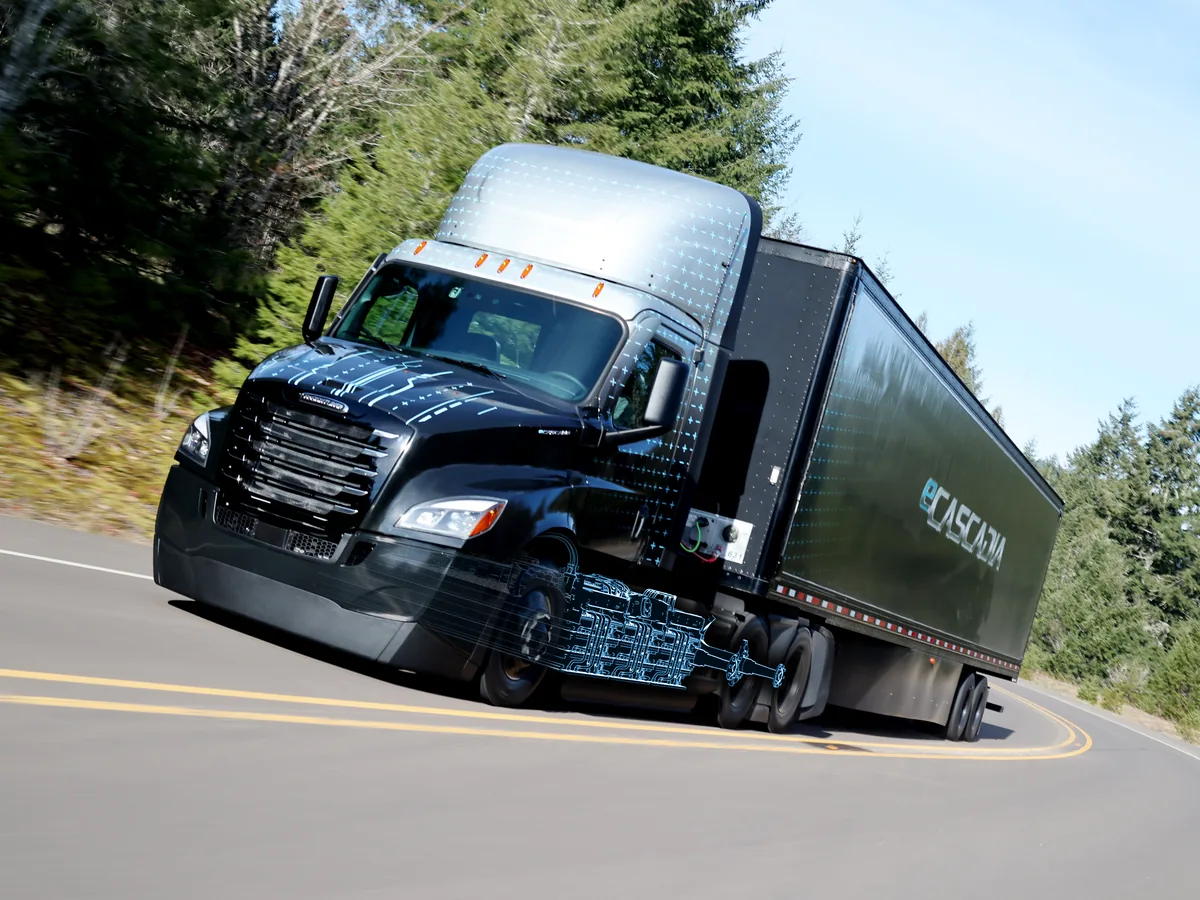
Freightliner illustration showing the batteries and electric powertrain through the side of an eCascadia tractor.

Energy, load & working reserve

Make the range useful to your operation.

Battery capacity in kWh describes stored energy. Charging power in kW describes how quickly energy is transferred. Plan both around the complete shift, including the energy used by the truck’s other systems.

  • Describe the whole route

    • Actual departure and return points
    • Load carried along each leg
    • Grades, stops and customer delays
    • The return trip to verified charging
  • Set a working reserve

    • A target arrival charge
    • Normal extra stops and diversions
    • Clear approval for route changes
    • Checked charging alternatives
  • Use recuperation well

    • Low, medium and high settings
    • Driver orientation to the controls
    • Smooth speed management
    • Service brakes and charging still required
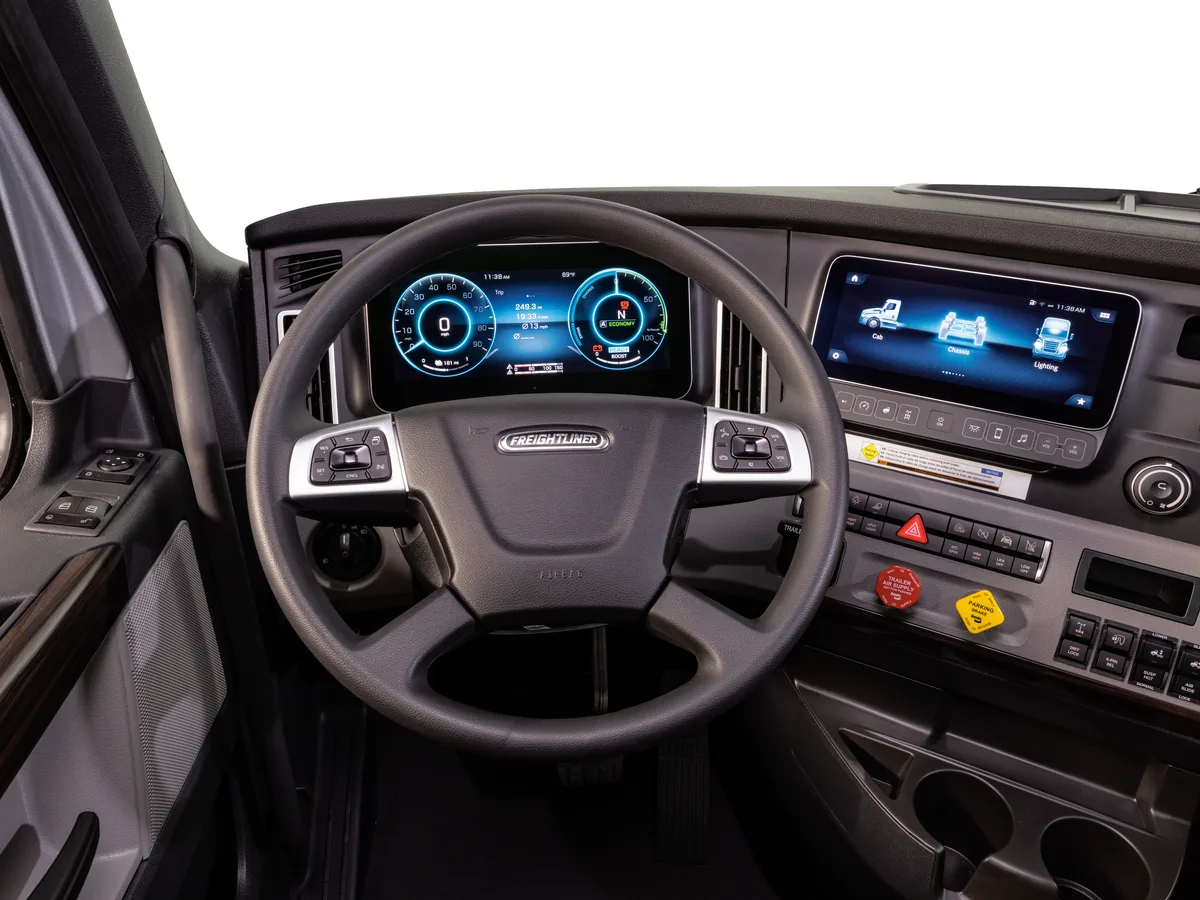
Production eCascadia day cab with a digital instrument cluster and an electric powertrain display beside the steering wheel.

116-inch BBC day cab

A familiar cab with an electric point of view.

Reduced powertrain noise and vibration accompany familiar Cascadia-based controls. A standard two-screen digital dashboard, tilt-and-telescoping multifunction steering wheel and customizable LED-backlit switches provide the driver interface.

Review seating, storage, reach to important controls and the energy information used during a shift. Include preconditioning and climate settings in the handover, especially for shared vehicles. The cab, charging connections and trailer access deserve a practical walkaround together.

Detroit Assurance & the equipped vehicle

Driver assistance with clearly defined roles.

Freightliner’s eCascadia material identifies ABA 5, passenger-side assistance, adaptive cruise control and lane-support functions. Confirm the fitted equipment and its operating limits. The driver remains responsible for observation and control.

Forward-collision assistance

ABA 5 can warn the driver and initiate braking in certain detected collision situations. Include the actual system’s operation, alerts and limitations in driver familiarization.

The eCascadia is a battery-electric Cascadia-based platform with its own equipment offering. Confirm the ordered safety package and keep following-distance decisions, observation and response to changing conditions with the driver.

Passenger-side assistance

Side Guard Assist provides warnings about detected objects in the passenger-side area. Active Side Guard Assist adds braking intervention in certain low-speed right turns involving a detected moving cyclist or pedestrian. Freightliner describes ASGA operation at 12 mph or less, approximately 19 km/h.

These functions have different roles and limited coverage. Dirty, icy or obscured sensors can restrict detection. Review the vehicle’s instructions and continue to use mirrors, direct observation and the normal checks around the tractor and trailer.

Speed & steering assistance

Freightliner describes Adaptive Cruise Control to 0 mph, Active Lane Assist and Lane Departure Warning in the eCascadia offering. ACC adjusts speed in response to traffic ahead; steering assistance operates within specified conditions, while lane-departure alerts provide additional information.

Confirm the included functions and their operating instructions on the proposed vehicle. Driver-assistance equipment does not make the truck autonomous or remove the need for attentive driving.

CCS1 DC charging

Charge for the next departure.

Published vehicle limits are up to 180 kW through a single port and up to 270 kW combined through an eligible dual-port arrangement. Delivered power varies during a session and depends on the charger, electrical supply, vehicle and conditions.

Freightliner advertises 0–80% in as little as approximately 90 minutes for the 291 kWh configuration or the larger 438 kWh configuration using dual-port charging under suitable conditions. This is not a 0–100% time. Plan around the energy to replace and the truck’s actual parking window.

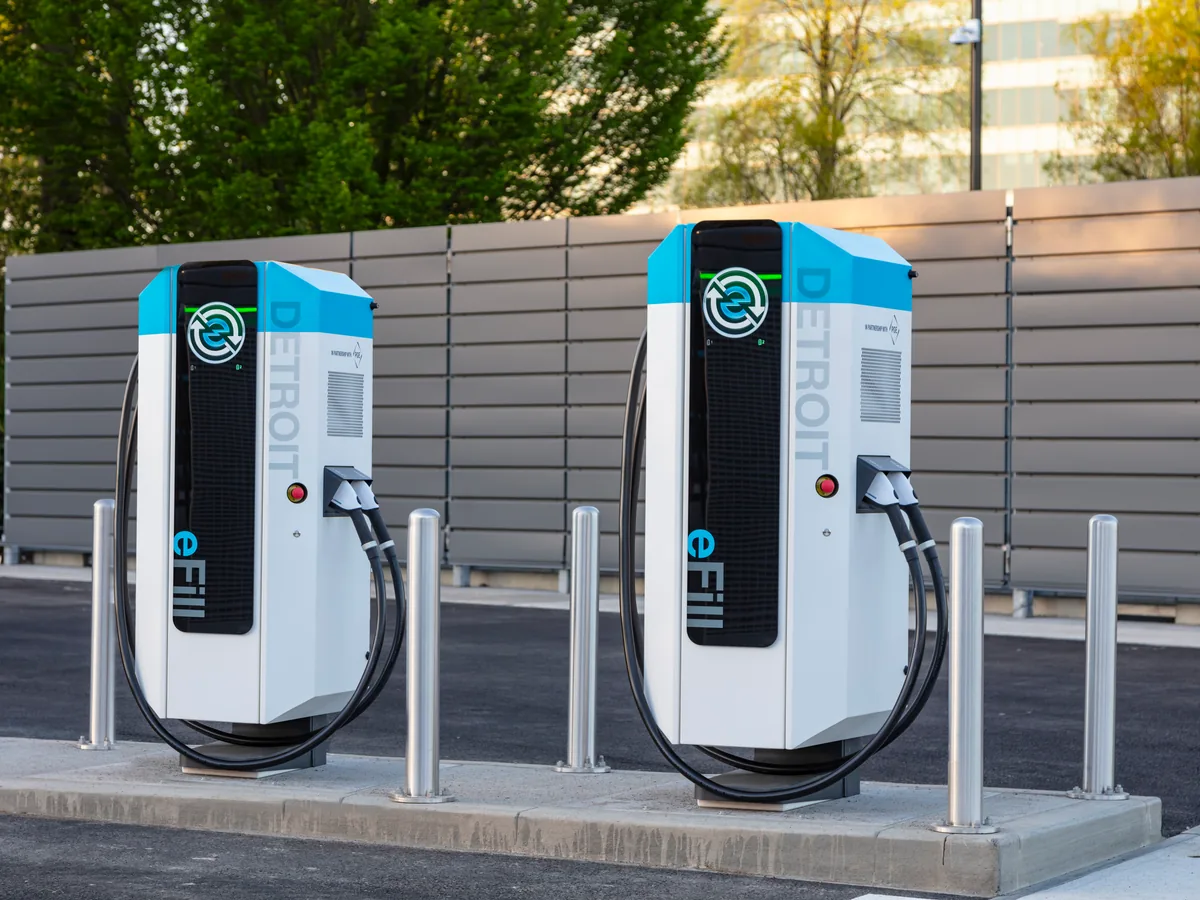
Two Detroit eFill charging units at the manufacturer’s Electric Island site in Portland, Oregon.

Infrastructure & daily use

Plan the depot alongside the truck.

Detroit eConsulting and eFill are manufacturer offerings to discuss as part of the project. Confirm Canadian availability, responsibilities and the qualified professionals who will design, install, commission and support the site.

  1. Define the charging window

    Identify how many vehicles return together, the energy they need and their next departure times. Include verified opportunity charging only where the schedule and site can support it.

  2. Engage the utility and site team

    Review existing electrical service, power demand and future expansion early. Route assessment, site planning and equipment selection should develop together with the vehicle specification.

  3. Make the parking position work

    Check cable reach, tractor-trailer access, protection from traffic and a clear exit. Include snow storage, clearing access and pedestrian routes, plus an agreed response to charging faults.

Canadian operating conditions

Prepare for the season before the shift.

Temperature affects range. Assess the actual route across the year, including the normal heaviest load, heating demand, parked time and the reserve needed for delays.

Precondition while connected

The truck can prepare cab and battery temperature while connected to a charger, including cabin warming and windshield defrosting. Set the readiness time and make confirmation part of the departure routine. Preconditioning does not guarantee summer range in winter.

Assess the demanding conditions

Freightliner recommends more detailed route analysis for operations consistently below −20°C. That is an assessment recommendation, not an operating cutoff. Review seasonal loads, charging access and a practical reserve without assuming a universal percentage of range loss.

Detroit Connect & electric-fleet tools

Turn vehicle information into the next decision.

Connected capabilities depend on the equipment, valid service agreement and applicable package. Confirm current Canadian availability, subscriptions, cellular coverage and charger compatibility with the proposed truck.

Vehicle health

Portal information and supported fault reporting can help connect a driver’s concern with maintenance planning. Decide who receives notifications and who owns the next action.

Route and charging insight

Available eRange Prediction considers load, weather, traffic and gradients. Charge Management Services can provide session, utilization and fault information. A prediction still needs an operating reserve and a response plan.

Learn from the completed shift

Use post-trip information to review energy use, arrival charge and readiness for the next departure. Combine driver feedback with charging results before repeating or expanding the assignment.

Electric equipment, ownership & deployment

eCascadia specifications & operating detail

Use the three configuration cards for matched battery, range, power and maximum GCW figures. These details explain the systems and planning behind them. Confirm the Canadian build and written vehicle, charging and support arrangements.

Vehicle & electric systems

The eCascadia is a Class 8 battery-electric tractor with a 116-inch BBC day cab. BBC means bumper-to-back-of-cab, not wheelbase, overall length or interior usable space.

Freightliner describes a Cascadia-based aerodynamic shape, electric-specific grille, LED lighting and two aerodynamic package choices. Review fairings, trailer coupling, battery protection and charging access around the actual working locations.

The cab includes a two-screen digital dashboard, multifunction tilt-and-telescoping steering wheel and customizable LED-backlit switches. Evaluate seat adjustment, storage and energy displays with the drivers who will use the truck.

Detroit ePowertrain integrates the battery system and single- or tandem-drive eAxles. The eAxle combines motors, transmission components and power electronics. Usable vehicle battery capacities are 291 or 438 kWh according to the selected configuration.

Battery monitoring and liquid heating/cooling manage cell conditions. Thermal management is part of the vehicle’s operation; ambient temperature, battery condition and departure preparation still matter to route planning.

The high-voltage system also supplies equipment such as the electric air compressor, while a separate low-voltage system serves controls and other components. Include cab comfort and vehicle-system energy in the assessment of the full shift.

Freightliner’s typical ranges are 155 miles for single-drive 291 kWh, 230 miles for single-drive 438 kWh and 220 miles for tandem-drive 438 kWh—approximately 249, 370 and 354 km respectively. The figures reflect target applications with diminishing loads and regenerative braking.

Use representative legs, freight carried, road gradients, speeds, stops and weather to assess the assignment. Driving range is not an out-and-back operating radius. Include the final return to charging and normal dispatch variation.

Set an arrival-charge target and identify which route changes need review. Check any alternative charging location before depending on it. For refrigerated work, assess the trailer’s separate power source and operating requirements.

Regenerative braking recovers some energy as the truck slows and returns it to the batteries. The eCascadia provides low, medium and high recuperation settings through a steering-column control.

Use practical orientation to introduce the controls, displays and response of the equipped truck. Smooth speed management and anticipation can support the operating plan, while the driver continues to follow the manual for the conditions.

Recuperation does not replace charging, recover all acceleration energy or remove the need for the service brakes. Include questions about low-speed movements and trailer positioning before regular dispatch begins.

Charging & seasonal planning

Freightliner specifies CCS1 DC charging. Published vehicle limits are up to 180 kW for single-port charging and up to 270 kW combined for eligible dual-port charging. These are accepted charging-power limits, not battery capacities or the power maintained throughout a session.

The approximately 90-minute, 0–80% claim applies under suitable conditions to the 291 kWh configuration or the 438 kWh configuration with dual-port charging. It does not provide a universal 0–100% duration.

Confirm the vehicle connection, compatible equipment, site supply, starting charge and operating conditions. A public charger also needs suitable physical access and space for the tractor-trailer. Verify both the equipment and location before adding them to a route.

Detroit eConsulting describes route and fleet assessment, power-demand analysis, site planning and coordination with utilities and contractors. Detroit eFill is a commercial charger family tested for integration with Freightliner electric trucks.

Review the first deployment and possible expansion together: return times, departure deadlines, parking orientation, cable reach and whether trailers remain coupled. Engage the utility early and have electrical design and installation reviewed by appropriately qualified professionals.

Confirm Canadian services, equipment and support responsibilities, including who supplies the chargers and who designs, installs and commissions the site. Agree who handles a charging fault and what happens to the next assignment.

While connected to a charger, preconditioning can prepare the battery and cab, including cabin warming and windshield defrosting. Define the readiness schedule and who confirms the truck’s status before departure.

Freightliner recommends more detailed analysis for routes consistently below −20°C. The reference is not a minimum operating-temperature specification. Thermal management and preconditioning do not guarantee that winter range equals summer range.

Review heating needs, seasonal loads, parking duration, delays and the hardest normal route. Include a realistic reserve, winter access to charging and a response to an interrupted session.

Ownership & support

Detroit Connect requires the connectivity platform and a valid service agreement. Portal, vehicle-health and fault information can help dispatch and maintenance coordinate their response.

Freightliner describes eRange Prediction using vehicle and load information, weather, traffic and gradients; Charge Management Services cover charging sessions, station utilization and faults. Post-trip information can support energy review and driver coaching when included in the package.

Confirm current Canadian services, compatible chargers, cellular coverage, licensing and enabled functions. Decide who acts on each type of notification. Predicted range is not guaranteed distance, and a fault message does not establish that the problem has been repaired.

Battery-electric propulsion removes diesel fueling, diesel engine-oil changes and DEF refilling from the tractor’s routine. The vehicle still needs scheduled inspection and maintenance, including eAxle lubrication and brake-system care.

Plan around the applicable vehicle manuals, including tires, steering, suspension, air systems, temperature-management equipment, low-voltage systems and charging connections. High-voltage diagnosis and repair require appropriately trained personnel and equipment. Drivers and general fleet staff should keep to their authorized inspection responsibilities.

Before deployment, confirm the qualified service location, electric-powertrain support, recovery arrangements and separate warranty terms for the truck, batteries and drive components. Agree which location will perform the required EV work before the truck enters regular operation.

Compare the proposed electric assignment with the work currently performed. Include vehicle acquisition, chargers, site work, electricity, maintenance, utilization and any change in route coverage. Available charging time is part of the operating plan.

Use the actual utility service and charging arrangement. Any incentive should be confirmed against the current program, applicant and vehicle requirements before it becomes part of the decision.

Detroit eConsulting includes energy-cost and infrastructure analysis among its services. Discuss where an assessment is needed, then measure route completion, departure readiness, energy use and interruptions during the first deployment. No universal saving or payback period applies to every operation.

Battery-electric propulsion produces no exhaust emissions at the tractor’s tailpipe. That is a specific benefit for freight movements through customer locations and populated areas, alongside the quieter driving experience.

A broader environmental assessment also considers vehicle manufacturing, electricity generation and separately powered equipment, including refrigeration. An electric tractor does not establish that every part of the combination has zero tailpipe emissions.

For fleet reporting, identify the work being electrified and the basis used to measure any reduction. Keep the claim tied to the activity and equipment actually assessed.

In December 2024, Schneider reported more than six million battery-electric fleet miles with nearly 100 eCascadias and a dedicated Southern California charging depot. DTNA also reported an eCascadia working in its Detroit, Michigan inbound logistics operation in 2024.

These are dated deployment examples, not predictions for an Ottawa fleet. They illustrate the need to plan the truck, charging facilities and daily routines together.

Choose a clear first assignment and compare the plan with actual performance: load, route completion, arrival charge, charging interruptions and driver feedback. Resolve repeated issues before extending the same routine to more trucks.

From a route to a vehicle enquiry

Start with the work you already understand.

A first conversation does not require a finished electric-fleet specification. A typical route, current trailer and description of the working day are enough to identify the next questions.

  1. Bring the assignment

    Share the route, normal and heaviest loads, trailer, daily distance, seasonal changes and extra movements dispatch needs to accommodate.

  2. Describe the charging opportunity

    Identify the proposed site, return and departure times and other vehicles using the facility. Note what is known and what still needs utility or infrastructure assessment.

  3. Confirm the vehicle and support

    Discuss configuration, Canadian availability, quantity and timing. Identify the manufacturer, charging and EV-qualified support arrangements required before a regular assignment begins.

Vehicle enquiries & configuration review

eCascadia availability

Check any listed eCascadia units or contact Sales about your proposed configuration and timing. Confirm the actual battery, drive arrangement, equipment and Canadian availability alongside the route and charging plan.

Browse all Freightliner inventory

Inventory is being updated.

Ask our sales team about available and incoming units.

Francis Canada Truck Centre

Start the conversation in Ottawa.

Our dealership provides Freightliner sales, parts and commercial-truck service support. For an electric project, confirm the appropriate EV-qualified service location, charging support and electric-powertrain warranty arrangements with the proposed vehicle.

Electric-truck FAQs

Your eCascadia questions, answered.

These answers explain the published vehicle offering and the information needed to assess a particular operation.

Vehicle & configurations

It is a battery-electric truck using Detroit ePowertrain. Stored electrical energy supplies propulsion, and charging forms part of the operating routine. It is not a diesel-electric hybrid.

Freightliner identifies short-haul and regional assignments including distribution, drayage and warehouse-to-warehouse transportation. Suitability depends on the complete route, load, reserve and charging plan rather than distance alone.

Published typical ranges are 155 miles for single-drive 291 kWh, 230 miles for single-drive 438 kWh and 220 miles for tandem-drive 438 kWh—approximately 249, 370 and 354 km respectively. These reflect target applications with diminishing loads and regenerative braking, not guaranteed distances. Review actual conditions and a working reserve.

Published usable capacities are 291 or 438 kWh for single drive, and 438 kWh for tandem drive. Choose the battery with the load, drive arrangement, route and charging time. Battery capacity is stored energy; charging power is a separate figure.

No. It is the published maximum gross combination weight for tandem drive, including the loaded tractor and trailer. Single drive is listed at 65,000 lb maximum GCW. Cargo capacity and applicable operating weights must be established for the completed combination; neither figure is GVWR or payload.

Charging & seasonal operation

Freightliner advertises 0–80% in as little as approximately 90 minutes for the 291 kWh configuration or the 438 kWh configuration with dual-port charging under suitable conditions. This is not a full-charge guarantee. Review the battery, starting charge, compatible equipment and actual conditions when setting the charging window.

Compatibility and access must be verified. Freightliner specifies CCS1 DC charging, and the site must provide suitable electrical performance and room for the truck. Check the charger and location before making them part of the route plan.

Assess the actual winter route, load, charging access and reserve. Preconditioning and battery temperature management support operation, but cold can affect range. Freightliner recommends closer route analysis for operations consistently below −20°C; that is not a stated operating cutoff.

Driver & ownership

The published eCascadia configuration is a 116-inch BBC day cab. Diesel Cascadia sleeper configurations are a separate offering. Review the cab and route requirements with Sales when comparing the models.

No. Recuperation returns some energy to the battery as the truck slows. It does not replace plugging in or correct use of the service brakes. Drivers should be familiar with the low, medium and high settings and follow the equipped vehicle’s manual.

Freightliner’s eCascadia material identifies Detroit Assurance with ABA 5 and describes passenger-side warning/active assistance, ACC and lane-support functions. Confirm the fitted equipment and limits. Warnings, braking and steering assistance have distinct roles; the vehicle remains under the driver’s control.

No. Diesel-specific tasks change, but inspections and maintenance remain, including eAxle lubrication and brake-system care. Review the full vehicle schedule, EV-qualified service location and support arrangements before regular operation. High-voltage work requires appropriately trained personnel and equipment.

Planning your purchase

Contact Francis Canada Truck Centre with the application, route, typical load, trailer, proposed charging location, quantity and timing. We can discuss the vehicle enquiry and identify the configuration, infrastructure and support questions for your project. A clear description is enough to begin.

Let’s explore where electric fits

Put your next route in motion.

Tell us about the freight you move, the route you run and the work the truck needs to complete. Our Sales Department can help identify the next steps toward an eCascadia vehicle enquiry.

Call Truck Sales