Commercial truck sales, parts and service specialists

Freightliner / Class 6–7 / Battery-Electric Delivery

eM2

All electric. Every stop matters.

Check eM2 availability
Vehicle class
Class 6–7
Power source
Battery electric
Day cab
106-inch BBC
Usable battery capacity
194 or 291 kWh; by configuration

Model overview

All electric. Every stop matters.

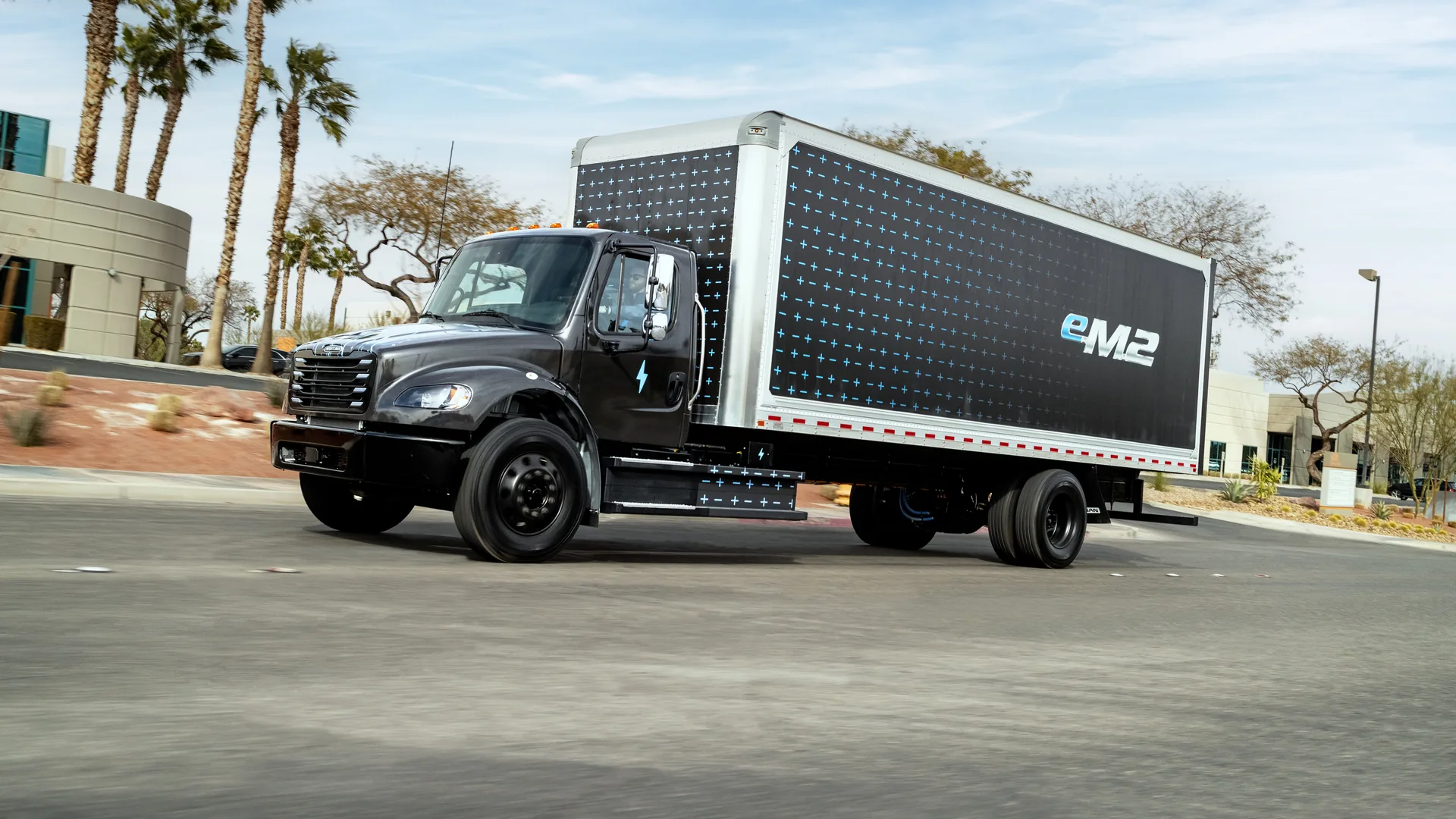
The Freightliner eM2 brings battery-electric propulsion to the M2 106 Plus platform, with integrated Detroit ePowertrain developed for pickup and delivery. Class 6 and Class 7 configurations pair different usable batteries and motor arrangements with a 106-inch BBC day cab. The truck, completed body and charging schedule can be planned around the deliveries your business needs to make.

At Francis Canada Truck Centre in Ottawa, we start with the complete assignment: what you carry, how you unload and where the truck returns between shifts. Compare the two published configurations below, then review current Canadian availability, body integration and EV-qualified support for the proposed build. Typical range and charging estimates require assessment against the actual equipment and operating conditions.

Sales resources

Build the right eM2

Discuss specifications, body applications, availability, and ordering with our commercial truck team.

Class, battery and power together

Two configurations. A clearer starting point.

Typical ranges reflect delivery-oriented load profiles and regenerative braking. Configuration, actual body, load, equipment use, driver behaviour and weather affect the result. Kilometres are rounded conversions; these are not guaranteed fully loaded distances.

GVWR includes the finished truck and its load, not cargo alone. The approximate 0–80% charging times below use the manufacturer’s CCS1 400 A condition with compatible equipment and suitable vehicle/site conditions; they are not full-charge times.

194 kWh / single motor

Class 6 eM2

  • GVWR: 26,000 lb
  • Usable battery: 194 kWh
  • Continuous power, Economy Mode: 190 HP
  • Performance Mode: 220 HP
  • Single motor; one Detroit drive axle
  • Typical range: approximately 290 km / 180 miles
  • 0–80% charging: approximately 60 minutes at CCS1 400 A

Review freight volume and the completed body as well as weight. A class designation does not establish the payload of the finished truck.

291 kWh / dual motors

Class 7 eM2

  • GVWR: 33,000 lb
  • Usable battery: 291 kWh
  • Continuous power, Economy Mode: 255 HP
  • Performance Mode: 300 HP
  • Dual motors; one Detroit drive axle
  • Typical range: approximately 402 km / 250 miles
  • 0–80% charging: approximately 90 minutes at CCS1 400 A

Assess the larger battery and vehicle rating against the work, body and charging window. Two motors do not mean two rear drive axles.

Applications to assess with your team

Build around the daily delivery.

Start with the loading routine, the customer locations and the return to the depot. These applications guide a discussion; each body, powered accessory and route needs a confirmed specification.

Urban pickup & delivery

Busy intersections and restricted entrances make each stop part of the specification. For parcels or packaged goods, review rear access, cargo handling and the time spent outside the cab alongside the road distance.

Retail & wholesale

Bring a representative delivery manifest. Identify what leaves the warehouse, what remains after each stop and any return collections. A steadily unloading route differs from one that remains heavily loaded all day.

Food & beverage

Define ambient, chilled or frozen freight and how it is handled. Delivery frequency, door openings and unloading equipment shape the body requirements and the energy used during the shift.

Refrigerated distribution

DTNA has described ePTO support for compatible refrigeration equipment. Confirm the current interface and body combination, then include temperature control, insulation and operating time in the route’s energy assessment.

Depot-based routes

The eM2 is designed around hub-and-spoke delivery work. Review actual return times, the parking window and whether another shift needs the truck. Charging should fit the depot’s loading and dispatch routine.

Specialized-body enquiries

Bring utility, sweeping or other equipment-intensive requirements for a separate review. The Detroit-powered delivery figures on this page do not establish the battery, drive system, ePTO or range of every vocational build.

Chassis packaging & completed-vehicle payload

Plan the body before the first delivery.

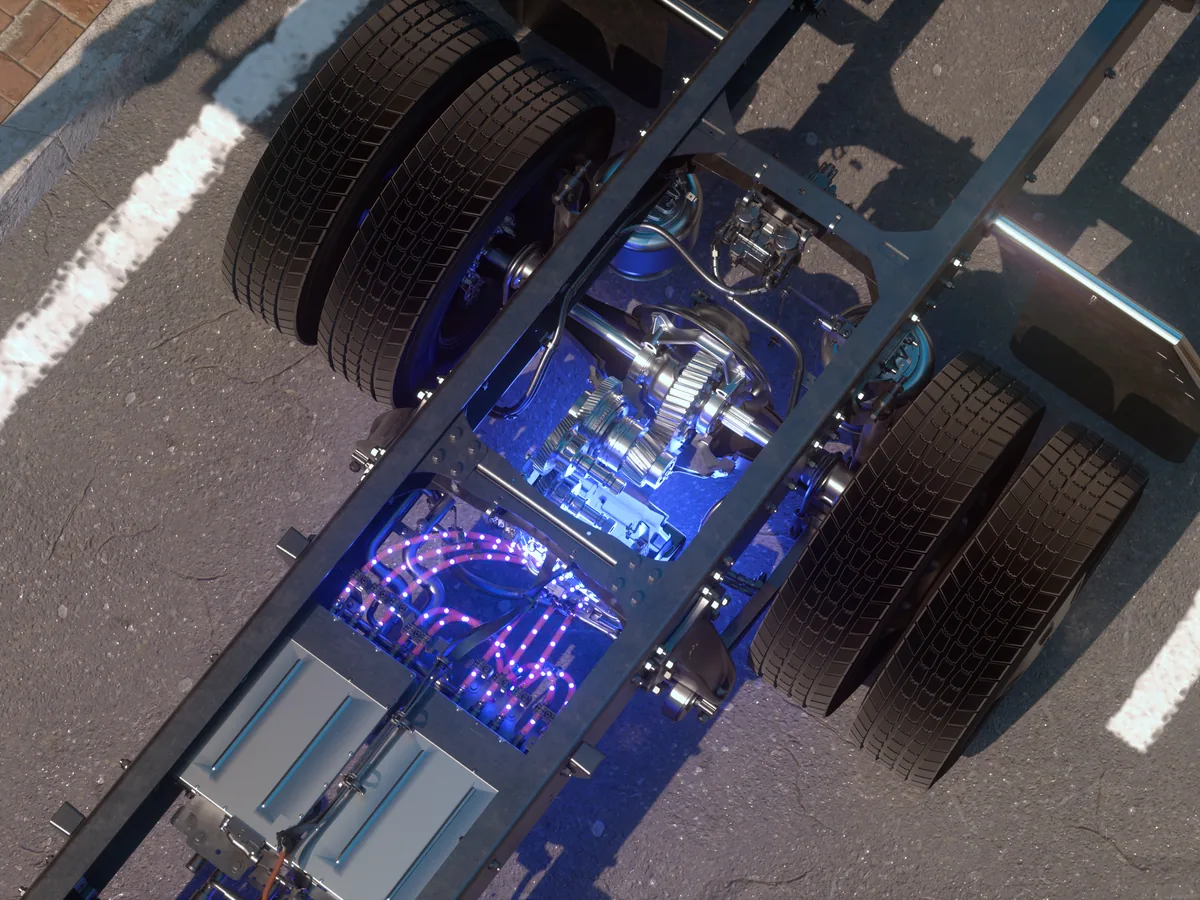
The eM2 prioritizes frame-rail space and compact battery packaging for body installation. Include the liftgate, refrigeration, cargo restraints, controls and service access in the initial body plan.

Bring the supplier’s dimensions, mounting requirements, electrical loads and estimated finished weight. GVWR includes the chassis, body, occupants, equipment and freight; review the actual payload and axle loading for the completed truck. Up to 55 degrees of wheel cut helps frame the access discussion, while wheelbase, body length and overhang determine how it fits the stop.

Overhead Freightliner illustration highlighting eM2 battery and electric components between the chassis rails.

Detroit ePowertrain

Electric propulsion designed as one system.

Batteries, electric drive and electronic controls work together through loaded starts and repeated stops. Choose the complete configuration around the assignment, including the energy used by the body.

Two-speed drive

The axle assembly integrates the motor, two-speed transmission and power electronics. Responsive acceleration comes from an electric drive system with its own operating controls.

One drive axle in both classes

Class 6 uses a single motor and Class 7 uses dual motors. Both use one Detroit drive axle. Compare the class, battery and motor arrangement together.

Economy & Performance modes

Published continuous Economy Mode output is 190 HP for Class 6 and 255 HP for Class 7. Performance Mode provides 220 and 300 HP respectively. Review mode selection during driver handover.

Range, reserve & energy use

Assess a working week, not one easy route.

Use the busiest normal day as well as the average one. The body, refrigeration or other electrically powered equipment shares the energy discussion with road travel.

  • Bring real dispatch information

    • Several representative routes
    • Freight remaining after each stop
    • Collections, detours and delays
    • Equipment used while stationary
  • Define the next departure

    • A practical arrival-charge reserve
    • The return trip to the charger
    • A dependable parking window
    • A plan for assignments outside the usual pattern
  • Introduce recuperation

    • Low, medium and high settings
    • Right-hand stalk and power-gauge information
    • Anticipatory driving and safe following distance
    • Service brakes and plug-in charging still required
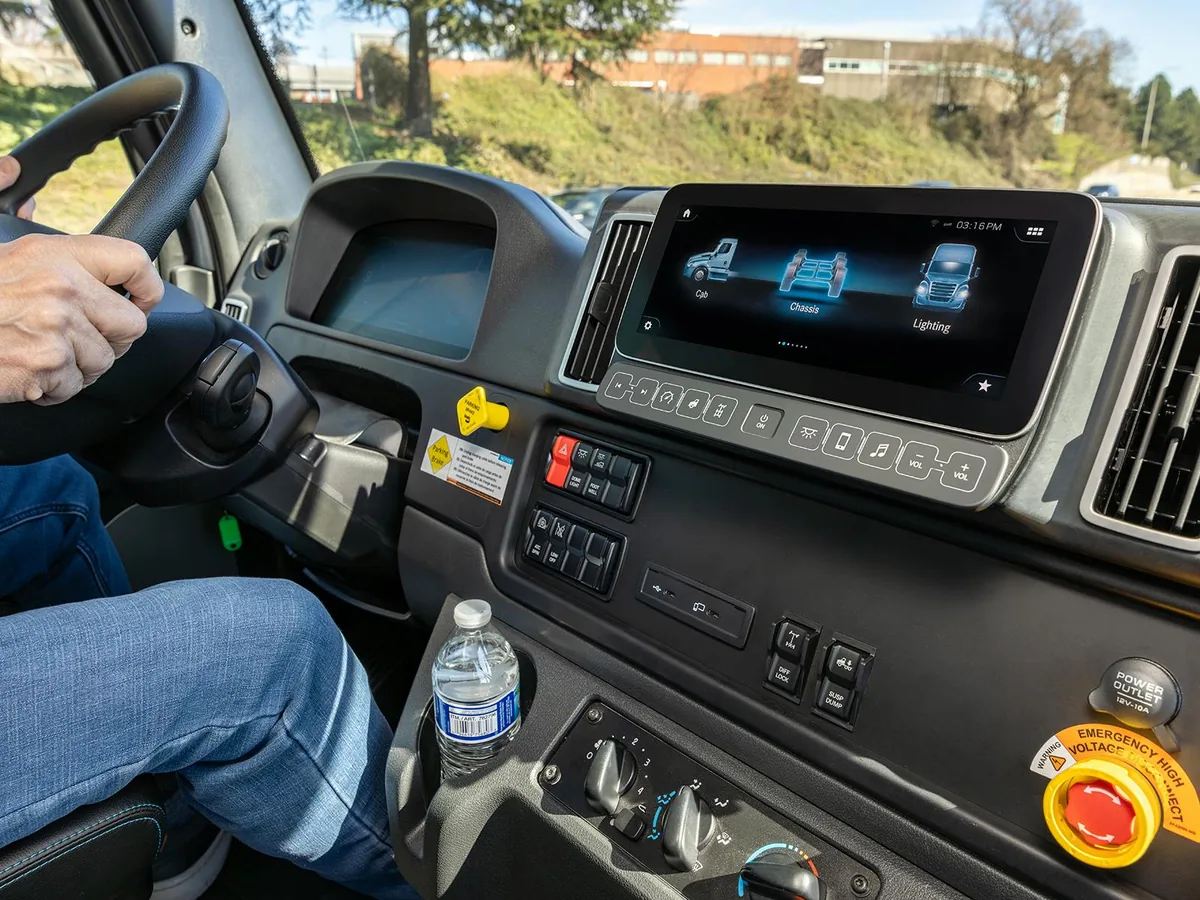
Driver at the wheel of a Freightliner eM2 with its digital instrument cluster, charging menu and cab controls visible.

Familiar layout, electric-specific information

A driver’s workspace for every stop.

A standard two-screen digital dash, adjustable seating and a tilt-and-telescoping multifunction steering wheel provide the driver interface. Configurable backlit switches and cab insulation support a practical working environment with less engine-related noise and vibration.

Review the displays before departure, on the route and while preparing to charge. The 2,500-square-inch windshield is part of the visibility story; check mirrors, steps, door clearance and the path to the body with the completed truck and the driver’s normal equipment.

Detroit Assurance & stopping support

Understand the assistance fitted to the truck.

The eM2 offering includes ABA 5, ACC to a stop, lane-departure alerts and passenger-side warnings. Confirm the installed features and review their operating limits with the driver. Assistance does not replace observation or vehicle control.

Forward traffic

ABA 5 can warn the driver and apply partial or full braking in qualifying situations involving vehicles or moving pedestrians. Detection has limits, and the driver must continue to maintain an appropriate following distance.

Adaptive Cruise Control adjusts speed in response to detected traffic ahead and is specified to operate down to a stop. Review its behaviour and the equipped vehicle’s instructions during familiarization. Stop-capable ACC does not make the truck autonomous or remove the need to supervise traffic.

Lane & passenger-side awareness

Lane Departure Warning provides visual and audible alerts for qualifying unintended lane departures. The eM2 manual describes operation above approximately 60 km/h; this is not an always-active guide for low-speed yard manoeuvres.

Side Guard Assist warns about detected objects or pedestrians in the passenger-side blind spot. It provides information rather than the differently named active side-braking function on other models. Confirm the actual package and keep mirrors, observation and completed-body sightlines central to the operating routine.

Stopping & moving away

The eM2 manual describes Hill Start Aid delaying service-brake release for up to three seconds while sufficient launch torque develops. This supports a controlled departure on a grade under the applicable conditions.

On appropriately equipped vehicles, Brake Hold Mode can maintain the service brake after the driver releases pedal pressure. Review the operating procedure and status indicators.

Both are driving aids. Before leaving the cab, use the parking brake and the vehicle’s prescribed securing process; temporary service-brake assistance is not a way to secure an unattended truck.

CCS1 DC charging

Charge for the next working day.

Freightliner specifies CCS1 DC charging with advertised acceptance of up to 180 kW per port. The manufacturer’s spec sheet gives approximate 0–80% times of 60 minutes for Class 6 and 90 minutes for Class 7 at CCS1 400 A, with compatible equipment and suitable conditions. These are not full-charge times or results every depot can deliver.

Define the expected arrival charge, departure target and available parking window. Confirm site power, charger compatibility, cable reach and physical access for the completed body. Stored battery energy is measured in kWh; charging power is measured in kW.

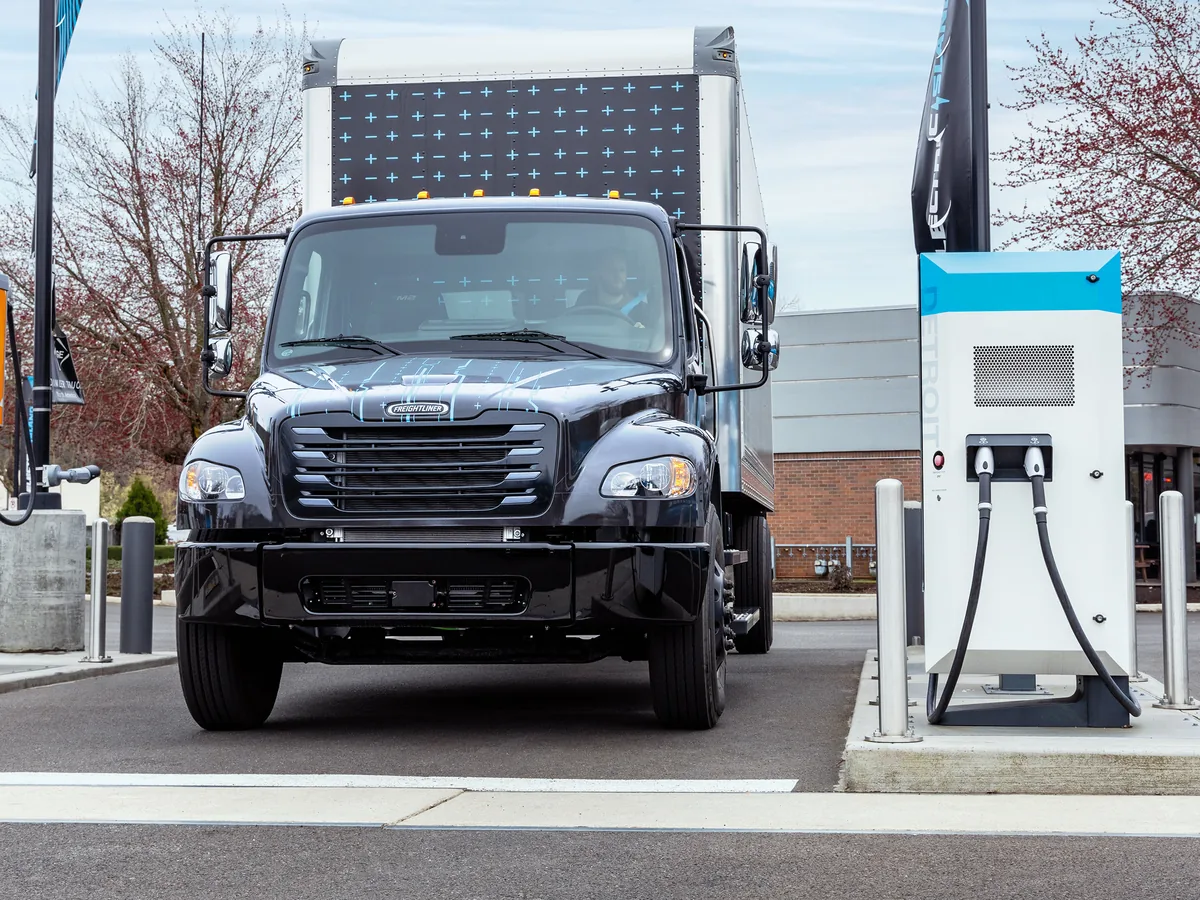
Freightliner eM2 box truck parked beside a Detroit eFill charging station.

Detroit eFill & depot coordination

Bring facilities into the truck plan.

Manufacturer eFill and eConsulting offerings can support the discussion of equipment, route energy and infrastructure. Confirm available services and the responsibilities for truck supply, body completion, electrical work, commissioning and daily operation.

  1. Map the parking and charging routine

    Identify return times, departure priorities and loading movements. A parked truck should have a clear path to connect, charge and leave without blocking the next delivery activity.

  2. Review power and equipment early

    Engage the site owner, utility and qualified electrical team. Compare suitable eFill or other compatible equipment with the available supply, cable positioning and completed-truck dimensions.

  3. Agree how the site will operate

    Confirm installation and commissioning, ongoing support and who handles a failed session. Include snow clearing, access protection and readiness checks before expanding the same routine to more vehicles.

Ottawa-area seasonal planning

Prepare for the weather on your route.

Heating, outdoor parking, body equipment and time between assignments belong in the original assessment. Use the conditions your business works through rather than one universal winter-range adjustment.

Precondition while connected

The eM2 can warm or cool relevant systems while connected to charging equipment before the shift. Review departure time, settings and charging arrangements with the people preparing the truck. Confirm readiness before road work begins.

Assess demanding winter assignments

Freightliner recommends detailed assessment for routes consistently below approximately −20°C. That is a planning recommendation, not a stated operating cutoff. Review seasonal loads, cab heating, equipment energy, charging time and the reserve needed for delays.

Connected fleet information

Know the difference between parked and ready.

Detroit Connect eServices and charging-management tools depend on compatibility, activation and the service agreement. Confirm the Canadian package and any recurring subscription cost with the proposed vehicle.

Vehicle status

Battery state, charging status and vehicle-health information can support dispatch readiness. Assign the checks required before departure and responsibility for any concern.

Charging sessions

Supported tools report sessions, faults, utilization and energy delivered. Confirm that a parked truck is successfully charging and agree who responds when a session fails.

Improve the next shift

Range prediction, post-trip analysis and eligible coordinated-charging functions can inform the plan. Review route completion, departure readiness, interruptions and driver feedback together.

The completed delivery truck

eM2 specifications & operating detail

Use the Class 6 and Class 7 cards for the matched battery, power, GVWR, range and charging estimates. Confirm current Canadian equipment, approved body integration and the actual operating assessment before finalizing the vehicle.

Vehicle & body planning

Class 6 pairs a 26,000-lb GVWR with 194 kWh usable battery capacity; Class 7 pairs a 33,000-lb GVWR with 291 kWh. Both use a 106-inch BBC day cab and a single Detroit drive axle. BBC is bumper-to-back-of-cab, not overall length or wheelbase.

GVWR covers the loaded vehicle. Account for the chassis, completed body, occupants, tools, equipment and other operating items when establishing cargo allowance.

Ask for the finished-vehicle weight calculation and axle review with the quotation. Freight volume and usable cargo space matter alongside the weight rating, especially for light but bulky deliveries.

Class 6 uses one motor; Class 7 uses two motors. Both use a single Detroit drive axle containing transmission components and power electronics, with a two-speed transmission in the production drive system.

Continuous Economy Mode output is 190 HP for Class 6 and 255 HP for Class 7. Published Performance Mode figures are 220 and 300 HP respectively. These are labelled operating-mode figures, not one interchangeable maximum for every truck.

Review the configuration with representative loads, repeated starts and the route’s grades. Driver handover should cover the actual drive controls, mode selection and fleet operating preferences.

Frame-rail space and compact battery packaging support body installation. Bring the body manufacturer’s dimensions, mounting requirements, finished weight and service-access needs into the chassis discussion.

Include liftgates, refrigeration, restraints, auxiliary electrical equipment and the controls used during a delivery. Ask the upfitter to document electrical loads, approved interfaces and expected operating time.

The body’s energy use belongs in route assessment. Confirm the electric vehicle’s integration plan and working sequence with the supplier rather than assuming a diesel M2 equipment arrangement transfers unchanged.

DTNA’s 2023 eM2 announcement described an electric power take-off option allowing compatible refrigeration equipment to draw energy from the high-voltage battery. Confirm the current Canadian interface, body and equipment combination before ordering.

Define operating temperature, insulation, loading and door-opening practices, time on board and the refrigeration duty. A dry-box delivery range estimate is not an unchanged refrigerated-truck result.

Additional vocational applications may involve different battery, drive or ePTO arrangements. Bring utility, sweeping or other equipment-intensive work for its own technical review instead of applying this Detroit-powered delivery configuration to every body.

Driving & readiness

The dedicated Freightliner specifications give typical ranges of 180 miles for Class 6 and 250 miles for Class 7, approximately 290 and 402 km. Configuration, load, driver behaviour and environmental conditions affect the result, with delivery-oriented profiles and regenerative braking behind the published estimates.

Assess several days of actual dispatch information. Include return collections, changing loads, stationary equipment operation, diversions and the busiest normal route.

Set a working reserve and a dependable charging opportunity. Decide how exceptions will be covered so the first electric assignment has a clear role without being expected to perform every possible job in the fleet.

Recuperation returns some deceleration energy to the batteries. The driver’s manual describes low, medium and high selections through the right-hand control stalk, with information on the power gauge.

Introduce the response of each setting during practical familiarization. Use anticipation and appropriate following distances, and follow the fitted vehicle’s operating instructions.

The manual notes that recuperative braking may not maintain a selected speed on steep roads. The service brakes remain essential. Regeneration recovers some energy but does not make the truck self-charging or remove the need to plug in.

The eM2 can be specified with up to 55 degrees of wheel cut and uses a swept-back bumper. Body length, wheelbase, overhang and unloading space still determine the room needed at a customer location.

A 2,500-square-inch windshield, steel-reinforced aluminium cab and dedicated battery side-impact protection are included in the published vehicle description. Check mirror placement and any equipment projecting from the completed body.

The two-screen dash, seating, steering adjustment, backlit controls and cab insulation support the driver’s workspace. Review access from the seat to the cargo area and agree reversing procedures and situations requiring a spotter.

LED headlights are standard beginning with 2026 eM2 builds; automatic deicing is optional. Confirm the equipment on earlier trucks and the fitted lighting, Intelligent High-Beams and automatic wiper/headlamp functions during handover.

Freightliner specifies CCS1 DC charging and advertises acceptance of up to 180 kW per port. Its eM2 spec sheet lists approximate 0–80% times at CCS1 400 A of 60 minutes for Class 6 and 90 minutes for Class 7. At CCS1 200 A, the same sheet lists approximately 130 and 200 minutes respectively.

These conditions show why the actual equipment and supply matter. Confirm starting charge, target charge, available power and vehicle conditions; a port limit is not the power delivered throughout a session or a universal charging duration.

Detroit eFill includes standalone and cabinet/dispenser arrangements, while eConsulting supports route, utility and site planning. Review cable reach, body height, parking orientation and access. Confirm the professionals and suppliers responsible for compatibility, installation, commissioning and support before relying on the site.

Ownership & support

Detroit Connect eServices provide supported battery-state, charging and vehicle-health information with range-prediction and post-trip tools. Charging-management services can report sessions, faults, utilization and energy delivered.

Eligible coordinated functions include staggered charging and vehicle preparation. Confirm the hardware, vehicle and charger compatibility, current Canadian package, activation and subscription terms.

Assign responsibility for failed sessions and departure checks. Connected information helps the team act; a parked vehicle or an enabled notification does not by itself establish readiness for the next route.

Electric propulsion removes propulsion-engine oil changes and diesel aftertreatment regeneration. Recuperation can reduce friction-brake wear, but the finished vehicle still needs inspection and upkeep.

Obtain the maintenance requirements for the exact truck and upfit, including tires, steering, suspension, brakes, cooling, low-voltage equipment and charging connections. Confirm the qualified service location and appropriately trained personnel for high-voltage work, routine chassis care and body-equipment repairs.

Freightliner provides driver-training resources searchable by model or VIN. Introduce displays, charging, recuperation, daily inspections, parking and concern reporting around the actual assignment. Relief drivers need the same handover as regular operators.

The eM2 builds on the M2 106 Plus platform with its own electric configuration. Compare the completed delivery truck, representative route and body requirements when assessing the alternative to an existing M2 specification.

Include the vehicle, body, charger, electrical installation, utility tariff, energy, maintenance and recurring software costs. Detroit eConsulting includes route, infrastructure and operating-cost assessment. Confirm any Canadian funding eligibility and approval separately before including it in the decision.

Series production began in 2023 with Canadian customers included in initial delivery plans; current build availability still needs confirmation. Define the first assignment and measure route completion, departure readiness, interruptions and driver feedback instead of assuming another fleet’s savings or timing.

Battery-electric propulsion produces no exhaust emissions at the truck. A broader assessment also considers electricity generation, vehicle and battery manufacturing and end-of-life treatment.

Identify the delivery work being electrified, the electricity supply and the energy source for the body equipment. An electric chassis alone does not establish how a separate auxiliary system is powered.

Keep fleet reporting tied to the route and equipment assessed. The tailpipe benefit is specific; a wider environmental conclusion requires the corresponding information.

Current vehicle enquiries

Discuss eM2 availability

Review any listed eM2 trucks or ask Sales about the class, body requirements and timing you need. Confirm current Canadian availability and the proposed sequence for both the chassis and completed body.

Browse all Freightliner inventory

Inventory is being updated.

Ask our sales team about available and incoming units.

Your Ottawa truck team

Start with Francis Canada Truck Centre.

Bring the freight, representative routes, required body and depot routine. You do not need to resolve every charging question before beginning a vehicle enquiry. Confirm EV-qualified service, high-voltage work, charging and body-support arrangements for the proposed deployment.

Electric delivery-truck FAQs

Your eM2 questions, answered.

Use these answers to prepare for a discussion with Sales, your body supplier and the team responsible for the route and charging site.

Configuration & performance

It is a battery-electric commercial truck for medium-duty pickup and delivery, built on the M2 106 Plus platform. The production lineup includes Class 6 and Class 7 configurations. Begin with the body and route, then review the appropriate electric build.

Class 6 uses a 194 kWh battery and one motor with 26,000 lb GVWR. Class 7 uses 291 kWh and dual motors with 33,000 lb GVWR. Both have one Detroit drive axle. Compare their matched power, range and charging figures with the complete assignment.

Freightliner’s dedicated specifications publish typical ranges of 180 miles for Class 6 and 250 miles for Class 7, approximately 290 and 402 km. These are not guaranteed fully loaded ranges. Assess the actual body, load profile, equipment energy, weather and operating reserve.

Charging & electric drive

The manufacturer’s spec sheet estimates 0–80% in approximately 60 minutes for Class 6 and 90 minutes for Class 7 at CCS1 400 A with suitable compatible equipment and conditions. These are not full-charge times. Confirm the actual supply, vehicle conditions and charging window for the next assignment.

Freightliner specifies CCS1 DC charging with advertised acceptance of up to 180 kW per port. Verify compatible equipment, site power, cable positioning and physical access for the completed truck. A connector type alone does not establish a practical charging installation.

Yes. Its electric drive integrates a two-speed transmission at the axle. The truck has electric-specific drive controls and Economy and Performance modes; driver familiarization should cover the configuration actually supplied.

No. It recovers some energy during deceleration, but the truck still needs external charging. Low, medium and high recuperation selections do not replace the service brakes, particularly where regeneration cannot maintain speed on a grade. Follow the vehicle’s operating instructions.

Body & operating conditions

DTNA has described an electric PTO option for compatible refrigeration equipment. Confirm the current Canadian body, interface and equipment combination before ordering. Include the refrigeration duty in route-energy assessment; dry-box delivery range is not an unchanged refrigerated-truck result.

Establish cargo allowance from the completed chassis, body, equipment, occupants and applicable axle and weight limits. Ask for the finished-vehicle calculation with the quote. The published 26,000-lb Class 6 and 33,000-lb Class 7 GVWR figures are not amounts of freight the truck can carry.

Assess cold-weather energy, cab heating, outdoor parking, powered equipment and available charging time for the real assignment. Plugged-in preconditioning can prepare relevant systems before departure. Use an appropriate seasonal reserve rather than a generic percentage range reduction.

Ownership & your enquiry

The eM2 offering identifies ABA 5, ACC to 0 mph, Lane Departure Warning and Side Guard Assist, with lighting and weather-assistance functions. Confirm the fitted equipment and its operating limits. These aids do not make the truck autonomous or guarantee collision avoidance.

Yes. The routine changes, but inspection and upkeep remain. Use the schedule for the exact truck and upfit, include charging equipment in the fleet plan, and confirm who handles high-voltage work, chassis service and body repairs before deployment.

Share what you carry, the required body, representative routes, approximate loads, depot location and time between shifts. Include powered-equipment needs, quantity and desired timing. A drawing or existing specification helps, but unresolved charging questions need not prevent a first conversation.

Every stop starts with the right plan

Put electric to work on your next route.

Tell us about the deliveries your business needs to make. Our Sales Department can help bring the eM2 configuration, body and deployment questions into one conversation.

Call Truck Sales