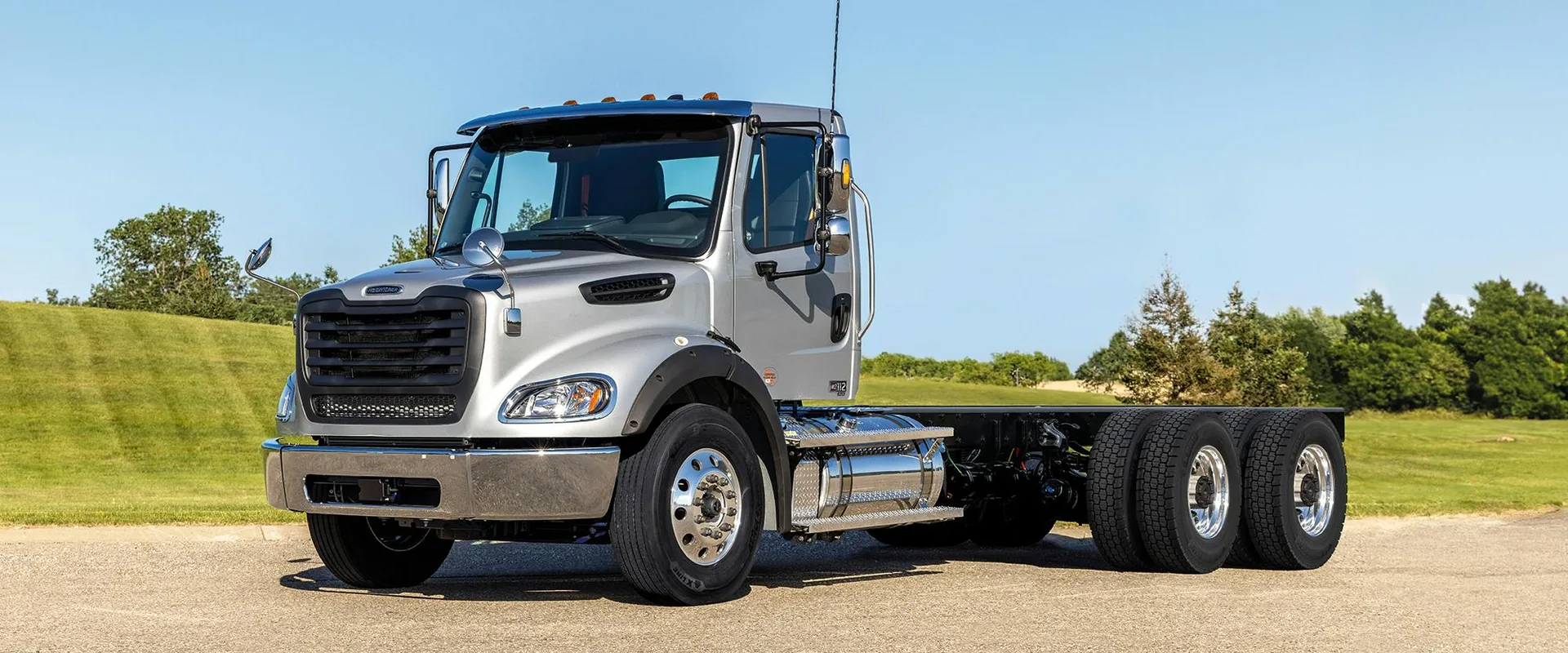
Regional distribution
Connect depots, suppliers and customers with a specification that reflects the balance between highway distance and delivery stops. Share typical loads, route lengths and the locations that are hardest to reach.
Freightliner / Class 7–8 / Regional & Commercial
Highway capability. Everyday practicality.
Model overview
Sales resources
Discuss specifications, body applications, availability, and ordering with our commercial truck team.
Regional routes & commercial applications
Start with a full working day: the loaded departure, the most restrictive customer location, the unloading routine and the return to the yard. Freightliner includes the M2 112 Plus in these application lineups; the completed chassis and body determine the right fit.
Connect depots, suppliers and customers with a specification that reflects the balance between highway distance and delivery stops. Share typical loads, route lengths and the locations that are hardest to reach.
Review trailer compatibility, changing loads and repeated yard movements alongside road performance. A dedicated assignment may need a focused specification; a mixed fleet also needs to identify where common controls and equipment matter.
Build around how the product is carried and unloaded. Side-load access, rear delivery, liftgates and refrigeration create different requirements for the body, driver access and time spent working at each stop.
For a commercial van body, consider loading height, freight handling and the expected load as well as cargo volume. Describe difficult stops so body length, access and the unloading routine can be reviewed together.
Involve the equipment supplier early. Material, loading and discharge methods, installed weight and powered equipment all influence the chassis. The tank or specialized body should be part of the specification from the start.
Match the collection style, route and body. Frequent stops, loading practices, equipment cycles and neighbourhood access require a complete-vehicle review; an application listing does not establish compatibility with every collection body.
Straight truck & tractor planning
A straight truck brings the cab, chassis and working body into one vehicle. Define how freight is loaded, where the driver unloads and which liftgate, pump or other equipment needs to travel with it.
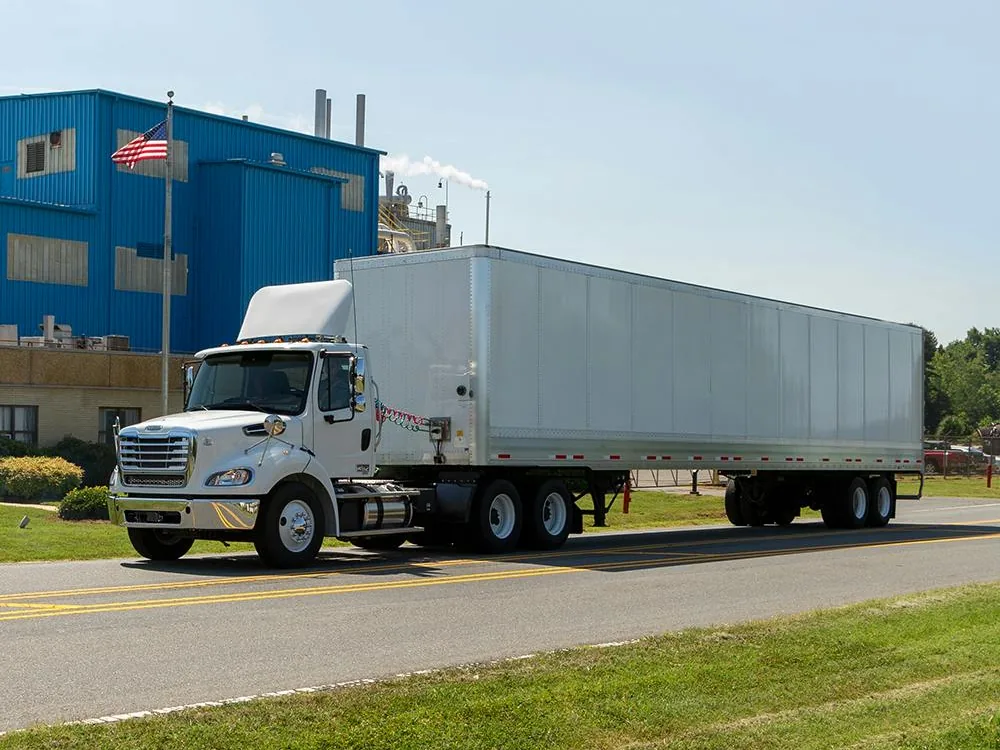
For a tractor, begin with the trailer and loaded combination: coupling, clearance, operating weight and room to position at the terminal and customer. Review axle, suspension and traction choices around that finished vehicle, including eligible all-wheel-drive configurations where the route requires them.
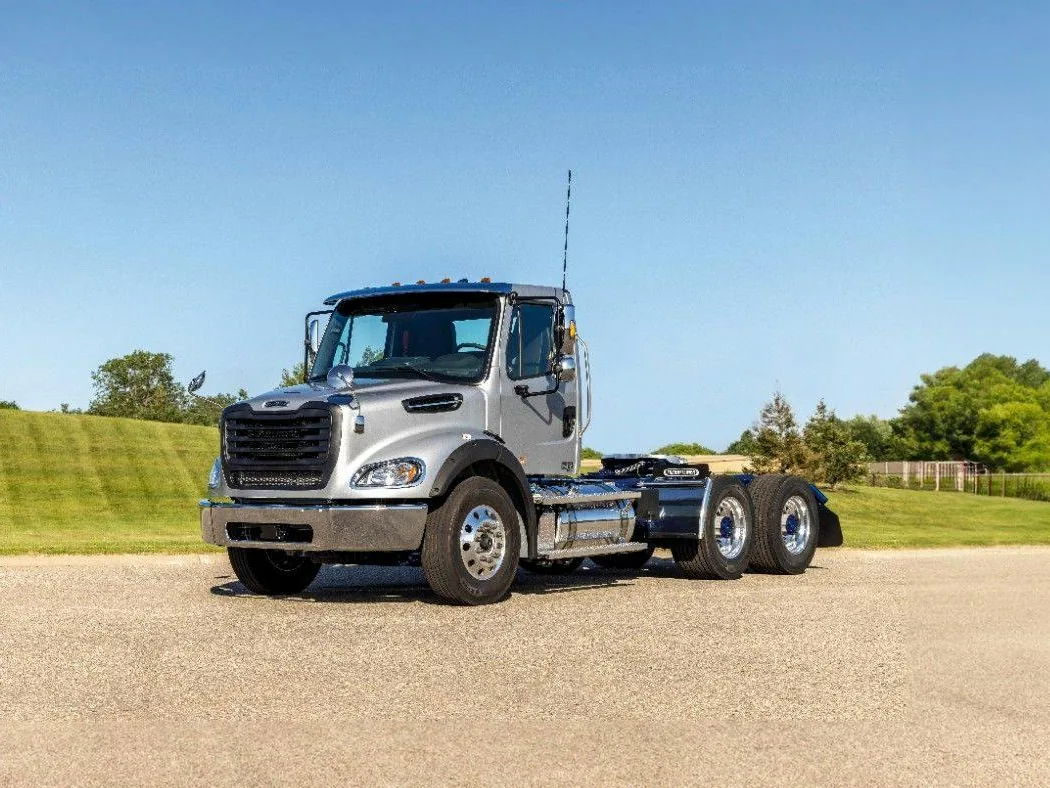
QuickFit, controls & working power
A body drawing or existing truck specification can reveal the details that matter: accessory demand, switch locations, working sequence and access for service. Plan those connections before installation.
Accessible electrical connection points, power sources and programmable switches support compatible body equipment. Define which functions belong in the cab and which are operated at the body.
Supported parameters and interlocks can be configured with the Daimler CHEC Tool. Work through the required sequence with the body builder, including installation validation and consistent controls across similar fleet trucks.
Bring the equipment’s power, speed and operating-duration requirements. Identify stationary or mobile operation so the engine, transmission, PTO and controls can be reviewed as an approved combination.
Manoeuvrability & driver sightlines
Up to 55 degrees of wheel cut, a set-back front axle and swept-back front bodywork provide a starting point for difficult loading areas. Wheelbase, body length, overhang and trailer geometry still determine the room the completed vehicle needs.
A sloping hood, low dashboard and 2,500-square-inch windshield open the forward view. Review available down-view mirrors and the lower passenger-door window from the driver’s seat. Bring a photo or sketch of a difficult entrance so the discussion starts with an actual stop.
Day, extended & crew configurations
Review the people, storage and equipment that must fit inside the cab alongside the body or trailer. BBC means bumper-to-back-of-cab; it is not overall truck length or usable interior space.
112-inch BBC
The shortest published cab is a starting point for daily local and regional routes. Check the occupants, work items and selected seating before finalizing the body or trailer layout.
132-inch BBC
Additional cab length creates more accommodation options. Define the need for people, storage or work items, then confirm the available arrangement on the proposed build.
160-inch BBC
For assignments that move a team, begin with the required approved seating positions. Review cab, storage, chassis and body dimensions together rather than assuming a passenger count.
Plus-series cab & everyday access
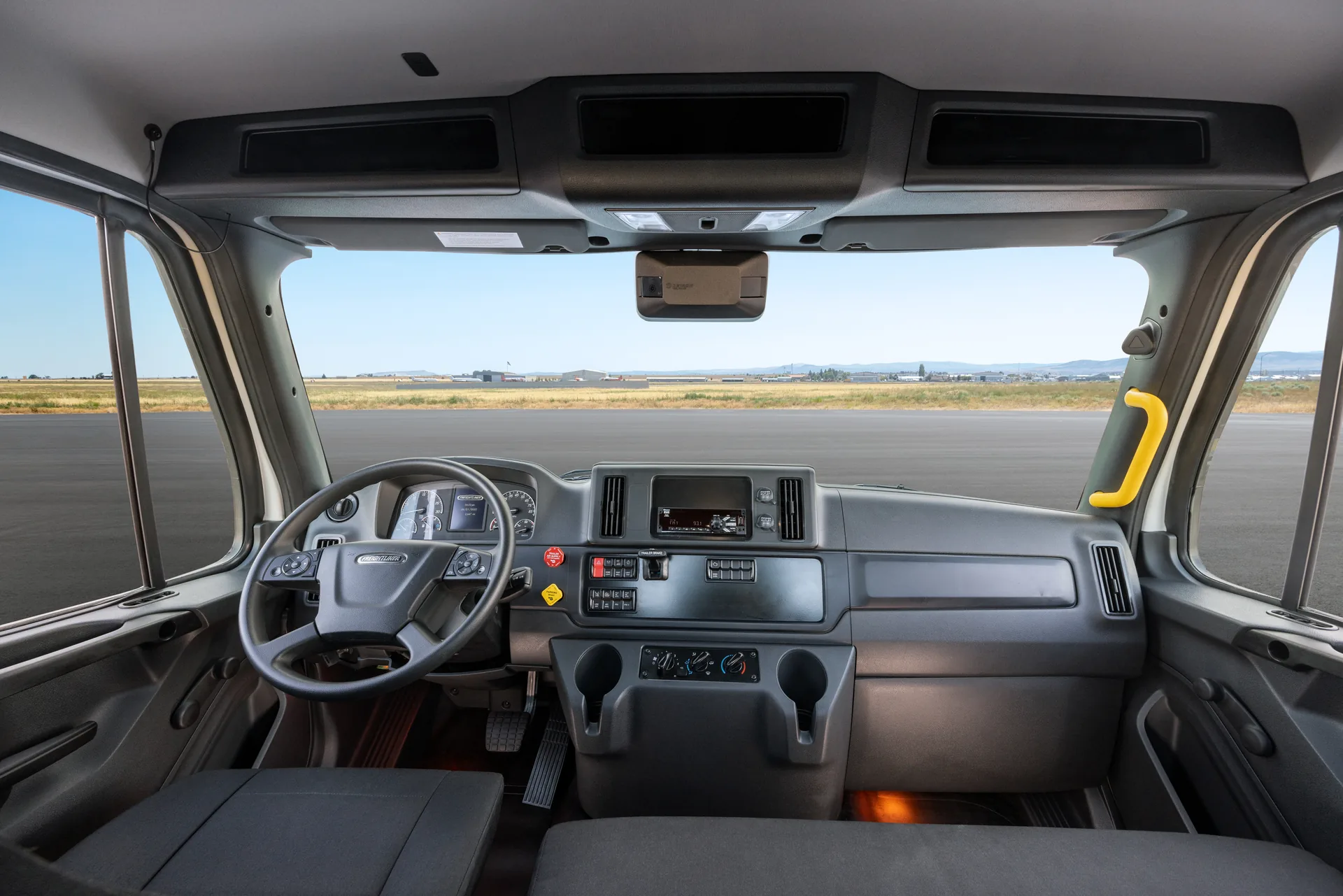
The redesigned dashboard, driver information centre, configurable switches and steering-wheel controls keep the working environment central to the specification. Adjustable seating, insulation and storage help the cab serve different drivers and assignments.
Compare Professional, Elite and Rugged trim packages with the actual seating and equipment included. Low entry and wide door openings also deserve a hands-on review: check the access path, handholds and space to open the door with the finished body in place.
Engines & approved transmission pairings
Freightliner’s published base list includes diesel and dedicated natural-gas choices. Confirm the engine generation, rating, transmission and current Canadian-market eligibility together. Natural-gas output and fuel-system arrangements are reviewed separately from the base model’s horsepower and torque range.
Detroit’s 12.8-litre, six-cylinder heavy-duty diesel is a published M2 112 Plus choice. The DD13 engine family reaches 525 horsepower and 1,850 lb-ft of torque; confirm the chassis-approved rating for the truck being quoted.
Describe loaded departures, road speeds, grades and equipment operation. Select the engine with the transmission, axle ratio and completed vehicle rather than choosing the highest rating in isolation.
Confirm generation, emissions configuration, Canadian eligibility and build timing on the actual order. A DD13 model listing or a wider engine announcement does not establish the generation or delivery date of an individual M2 112 Plus.
Freightliner lists the L9 with a domicile qualification. Sales can review availability for the intended market and the approved rating with the chosen chassis and transmission.
Cummins describes replaceable cylinder liners, a variable-geometry turbocharger and integrated engine-and-aftertreatment controls. Existing maintenance knowledge, parts planning and the engines already in a fleet can be useful considerations alongside road performance.
Bring the duty cycle and equipment requirements into the same discussion. The full engine-family rating range is not automatically available in every M2 112 Plus configuration.
The published M2 112 Plus engine list includes the Cummins L9N. This uses a dedicated natural-gas engine and approved fuel system; a diesel truck cannot simply be filled with a different fuel.
Review fuel access, daily route length, storage packaging, driver procedures and service resources before choosing the chassis. Cummins identifies renewable natural gas compatibility subject to its applicable fuel requirements. That does not by itself establish the emissions outcome of a particular operation.
Confirm the offered engine rating, Canadian build eligibility, fuel-system layout and support arrangements separately. The base model’s 260–525 HP and 730–1,850 lb-ft figures are not presented as the rating range for an L9N-equipped truck.
The DT12 On-Highway is a 12-speed automated manual: clutch operation and gear changes are automated, with a two-pedal driver layout. Freightliner’s base specifications name DT12-HE and DT12-HL variants.
Detroit describes Economy, Performance and manual operating modes within the On-Highway family. Review the variant, programming and included functions for the proposed truck. Repeated starts, highway travel and careful positioning at customer locations all belong in that discussion.
The approved engine/transmission combination matters. Ask Sales to confirm equipment-drive compatibility and any application-specific requirements before deciding on the complete driveline.
Allison 3000 and 4000 Series automatics appear in Freightliner’s published M2 112 Plus list. The appropriate unit depends on the engine, operating weight, duty cycle and installed equipment.
For stop-intensive or body-equipped work, define the loading cycle, operating speed and PTO demand before selecting the transmission. Include how the truck moves when loaded and what it needs to power while working.
Confirm the exact series, rating and approved pairing for the Canadian build; a model-level list does not mean every engine and transmission can be combined.
The published specifications include Eaton Fuller manuals with 9, 10, 11, 13 or 18 speeds and Eaton UltraShift PLUS automated manual options. These are distinct choices, subject to the applicable build and engine pairing.
Consider driver familiarity, route demands, equipment compatibility and the existing fleet. Consistent operating routines can be useful when drivers change trucks, while particular assignments may justify a different specification.
Review the transmission and approved rating with the complete vehicle. Confirm availability for the intended application and timing rather than treating the published options as interchangeable components.
Driver assistance & parking
Detroit Assurance with ABA 5 and other assistance features depend on the selected equipment and powertrain. Review the fitted systems and operating limits at handover; the driver remains responsible for observation, control and correct parking procedures.
A closer look at the completed truck
The published base model figures describe a range, not every truck. Confirm the approved GVWR, GCWR and actual payload or towing requirements for the chassis, body and trailer being considered. Natural-gas ratings and available equipment require their own build review.
Freightliner publishes Class 7–8, 260–525 base horsepower and 730–1,850 lb-ft of base torque for the M2 112 Plus. Natural-gas engine output is separate and must be confirmed for the proposed configuration.
Obtain the specific vehicle’s approved GVWR and GCWR. GVWR concerns the loaded truck; GCWR concerns the loaded combination. Neither is the amount of freight a body can carry.
Account for the chassis, body, equipment, occupants and operating items when reviewing usable payload. For a tractor, include the trailer and loaded combination. Individual axle or engine figures cannot establish the completed truck’s cargo or towing capability on their own.
A straight-truck build brings loading method, body length, equipment and operator access together on one chassis. A tractor specification also needs trailer coupling, clearance, loaded-combination and yard-movement information.
Freightliner lists Detroit and Meritor axles and multiple suspension families. Select the compatible components around body weight, freight distribution, ride requirements and the route surfaces.
An all-wheel-drive option is identified for eligible applications. Describe where traction is needed and confirm the available chassis, powertrain and body combination for the Canadian market.
QuickFit provides multiplexed electrical architecture, accessible connection points, power sources, programmable switches and configurable interlocks. The Daimler CHEC Tool supports viewing and modifying eligible electrical configurations and parameters.
Work through what each function must do, who operates it and which conditions must be met before it can operate. For similar fleet trucks, discuss consistent switch locations, identification and operating sequences.
The body builder remains responsible for the engineering, installation and validation of the completed vehicle. Include operating instructions and service access in the handover plan.
For a liftgate, pump, discharge system or other powered equipment, obtain the supplier’s power, speed, load and operating-duration requirements before finalizing the truck. Establish whether equipment operates stationary, while moving or both.
Review the approved PTO arrangement with the selected engine and transmission. Mounting, routing, controls and engagement conditions are part of the same installation.
Include electrical accessories and service access as well as mechanical power demand. A body drawing or an existing completed specification is useful for identifying what the next vehicle needs to retain or change.
Published cab dimensions are 112-inch day-cab BBC, 132-inch extended-cab BBC and 160-inch crew-cab BBC. BBC is bumper-to-back-of-cab, not overall length, wheelbase or usable interior length. Confirm approved seating and the offered storage arrangement.
Freightliner lists Professional as the standard trim, with Elite and Rugged choices. Review actual package contents, cleaning needs and driver preferences rather than treating a photograph as a complete equipment list.
The Plus interior includes a redesigned dashboard, driver information centre, configurable switches, steering-wheel controls, seating and insulation improvements. Evaluate entry, handholds, door-opening space and the driving position with the finished body and the clothing used on the job.
Freightliner publishes up to 55 degrees of wheel cut, with a set-back front axle and swept-back front bodywork. Actual manoeuvring space depends on wheelbase, body, rear overhang and any trailer; wheel cut is not a universal turning-circle measurement.
The sloping hood, low dashboard and 2,500-square-inch windshield support the forward view. Available down-view mirrors and a lower passenger-door window add sightline choices. Review these from the driving position with body equipment and accessories included.
LED headlights became standard beginning with 2026 M2 112 Plus builds, with automatic deicing optional. Confirm the installed headlamps and optional equipment when comparing earlier trucks or specific inventory units.
Detroit Assurance with ABA 5 is offered on supported M2 112 Plus configurations. In qualifying situations, Active Brake Assist 5 can warn the driver and progress to partial or emergency braking. Its operating limits remain part of the equipped vehicle’s instructions.
Adaptive Cruise Control adjusts speed to help maintain the selected distance from a detected vehicle ahead. Freightliner describes operation down to 10 mph, approximately 16 km/h, and down to a stop with a Detroit engine and DT12 transmission. Confirm the actual powertrain and installed capability.
Lane Departure Warning alerts the driver; it is not automatic steering correction. Available Side Guard Assist warns about detected objects or pedestrians on the passenger side. These functions complement mirrors, observation and the driver’s control of the completed vehicle.
Freightliner announced standard backup cameras across its vocational and medium-duty trucks in 2026. Confirm the installation or body-builder preparation on the proposed M2 112 Plus.
The optional full Backup Alert package combines a rear camera, proximity sensor, audible warnings and a seven-inch in-cab display. Mounting choices include an end-of-frame arrangement or preparation for positioning during body installation. Plan the useful view around the completed body, liftgate and equipment. The package provides visibility and warnings, not automatic reverse braking.
Available Bendix IntelliPark includes an anti-roll-away function intended to apply the parking brake in specified conditions when it has not been set. Review the fitted controls and follow the correct procedure to secure the vehicle before leaving the cab.
The M2 112 Plus uses a steel-reinforced aluminium cab, corrosion-resistant e-coating and protected chassis wiring. Its hood opens nearly 90 degrees to provide service access.
Carry that access planning through the body installation. Check room around routine service points, equipment connections and components that need inspection or cleaning.
Use the applicable engine, chassis, transmission and body maintenance instructions. Describe kilometres, stops, equipment hours and working conditions when arranging the maintenance plan. Identify body systems that need separate specialist support and decide how operator concerns will reach the person arranging service.
On compatible vehicles, Detroit Connect provides vehicle-health information and fault trends. Virtual Technician reports supported powertrain faults with information that can help maintenance personnel assess the next step.
Available services can include Safety Event Viewer and supported remote parameter or firmware updates. Hardware, engine compatibility, activation, package contents and subscription terms determine the functions on a particular vehicle. Confirm included services, term and any ongoing cost.
Decide who receives notifications, who reviews developing concerns and how driver reports are recorded. Connected information supports that process while the vehicle’s warnings and the need for appropriate diagnosis still apply.
Three steps toward the right specification
An existing truck specification, a body supplier’s drawing or a description of a difficult delivery is enough to begin. We can help identify the details still needed for an M2 112 Plus quotation.
Share the freight, typical load, highway distance, stops and restrictive locations. Include how the truck is unloaded and what needs to change from the vehicle you use today.
Bring the body or trailer, approved seating, loading equipment and power requirements. Include operator access, storage, maintenance and any natural-gas fuel-system needs.
Review ratings, powertrain pairing, installed equipment and support arrangements. Discuss quantity and desired timing so Sales can check the eligible configuration and availability.
Current inventory & ordering enquiries
Review available M2 112 Plus trucks or ask Sales about a configuration for your operation. Compare the actual engine, transmission, cab and installed equipment with the body or trailer you intend to use.
Inventory is being updated.
Ask our sales team about available and incoming units.
Francis Canada Truck Centre
Start the ownership discussion while the truck is being specified. Keep the chassis, body and equipment information together so the right team can help with the next step.
Review the application, body or trailer, cab and powertrain with our Sales Department. We can help identify the information needed to compare available vehicles or prepare a configuration enquiry.
Buying & operating FAQs
Use these answers to prepare for a discussion with Sales, your body or trailer supplier and the drivers who know the route.
It is a Class 7–8 commercial platform for regional distribution, delivery and other working applications. It can be specified as a straight truck or tractor, with the completed configuration chosen around the freight, route and equipment.
The two models have different published powertrain choices and cab dimensions. The M2 112 Plus lists the DD13 and DT12 On-Highway, while the M2 106 Plus has its own engine and transmission lineup. Compare the body or trailer, working loads and route before deciding. Each model’s published ranges still require confirmation for the actual Canadian build.
Freightliner lists Detroit DD13, Cummins L9 diesel and Cummins L9N natural gas. Market, generation, rating, fuel-system requirements and the approved transmission pairing must be checked for the proposed build. The L9 has a domicile qualification; a listing alone does not establish Canadian availability.
Freightliner’s published base figures are 260–525 horsepower and 730–1,850 lb-ft of torque. These do not describe every powertrain combination. Obtain the actual approved engine rating, with natural-gas output reviewed separately from that base range.
Yes. Allison 3000 and 4000 Series automatics are listed, alongside automated manual alternatives such as DT12 On-Highway and Eaton UltraShift PLUS. An automated manual automates clutch operation and gear selection but is a different transmission type. Confirm compatibility with the chosen engine and application.
Yes. Published BBC dimensions are 112 inches for day cab, 132 inches for extended cab and 160 inches for crew cab. Review the approved seating, storage and equipment on the proposed build rather than assuming a passenger count from the cab name.
Yes. QuickFit and the Daimler CHEC Tool support compatible body electrical integration and configurable functions. Bring the equipment supplier into the process so mounting, power, controls, operating sequences and installation validation can be reviewed together.
Freightliner identifies an all-wheel-drive option for eligible M2 112 Plus configurations. Describe the surfaces, traction requirements and the rest of the route so Sales can confirm whether an approved Canadian build suits the assignment.
Freightliner identifies stop-capable operation with a Detroit engine and DT12 transmission. Other configurations do not necessarily have the same capability. Confirm the actual powertrain, installed equipment and operating instructions on the truck you are considering.
The available Backup Alert package provides a rear view, proximity information and audible warnings. It does not automatically brake the truck in reverse. Confirm camera positioning around the completed body and continue to use the required driver checks and site procedures.
Freightliner announced standard LED headlights beginning with 2026 M2 112 Plus builds. Automatic deicing is optional. Confirm the installed equipment when comparing earlier trucks or individual inventory units.
That must be established from the completed vehicle’s approved GVWR, GCWR and installed equipment. Neither an engine rating nor a model-level figure guarantees payload or towing capacity. Provide the body, trailer and intended load for a complete specification review.
Describe the application, usual load, route, required occupants, body or trailer, quantity and desired timing. Include powered-equipment or natural-gas requirements where relevant. An existing specification or body drawing is helpful, but a clear description of the work is enough to start.
Walkaround
3 photos
Start with the complete working day
Tell us where the truck needs to go, what it needs to carry and what it needs to do when it gets there. Our Sales Department can help bring the cab, powertrain and working equipment into one specification.